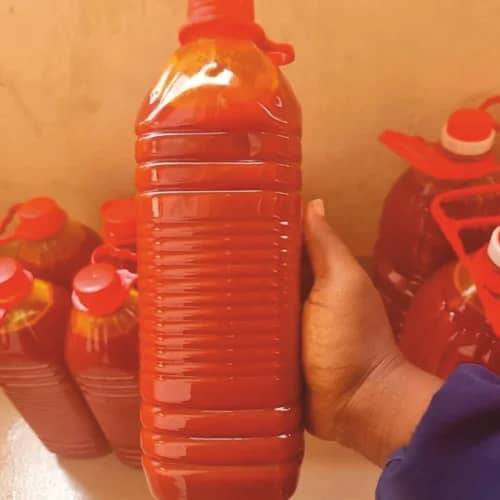
Buying palm oil from Nigeria is not complicated, but it is unforgiving of a step missed in the wrong order. Most of the problems first-time buyers hit, whether that is cargo held at the port, a specification dispute on arrival or a payment released against the wrong document, trace back to sequencing rather than to anything exotic. This is the order the process actually runs in.
1. Decide what you are buying, precisely
"Palm oil" covers a family of products that behave completely differently. Before you approach anyone, settle three things:
- Which product. Crude palm oil (CPO) if you are refining. RBD refined palm oil if you are manufacturing food. Palm kernel oil (PKO) if you are making soap, surfactants or cosmetics, since it is a lauric oil and chemically closer to coconut than to palm oil.
- Which specification. For CPO the number that matters most is free fatty acid, where 5% maximum is standard export grade. For RBD it is colour and FFA at 0.1%. For PKO it is the lauric fraction, and whether you need crude or fully refined.
- What volume, over what period. A single 20 ft container is roughly 20 metric tonnes of oil. Whether you are buying one or twelve a year changes your pricing, your terms and how seriously a supplier will engage.
Turning up with those three answers converts a vague enquiry into a quotable one. It is also the fastest way to find out whether the person you are talking to actually knows the product.
2. Qualify the supplier before you qualify the price
Nigeria's palm sector has genuine exporters and a long tail of intermediaries who will quote anything and source it afterwards. The difference shows up as soon as you ask specific questions:
- Can they name the mills and cooperatives the product comes from?
- Will they arrange independent pre-shipment analysis by SGS, Bureau Veritas or Intertek at origin, before loading, on their own initiative rather than yours?
- Do they hold a registered company, a tax identification number and an export licence you can verify?
- Can they describe their loading protocol for bulk oil, including heating and discharge?
A supplier who answers those crisply is running a supply chain. One who deflects straight to price is running a spreadsheet.
3. Agree the specification in writing
The contract should state the parameters you will test on arrival, the method used, and the tolerance. For CPO that typically means FFA, moisture and impurities, and deterioration of bleachability index. Name the inspection body and say who pays for it.
Specify the tolerance as well as the target. A contract that says "5% FFA max" with no stated margin invites an argument over a result of 5.1%.
4. Choose your Incoterm deliberately
FOB puts the cargo in your control at the Nigerian port and suits buyers with their own freight arrangements. CFR and CIF hand the ocean leg to the seller, which is usually simpler for a first shipment. DAP delivers to your door and costs the most.
Whichever you choose, be clear about where risk transfers. That is what decides whose insurance responds if something goes wrong mid-voyage.
5. Plan the documentation before production, not after
This is where most delays live. A Nigerian palm oil export typically needs:
- Commercial invoice and packing list
- Bill of lading
- Certificate of origin
- Phytosanitary certificate
- Independent pre-shipment analysis report
- SONCAP documentation, depending on product and destination
Each has its own issuing authority and lead time. Run them in parallel with production rather than discovering them one at a time afterwards. That difference alone is often two or three weeks.
Your own side matters too. Check what your customs authority requires for a plant-derived food or technical product from Nigeria, and brief your customs broker early. The most expensive delays happen at the destination, not the origin.
6. Structure payment so both sides are protected
An irrevocable letter of credit at sight is the standard instrument, and it protects both parties: the seller ships against a bank's undertaking, the buyer pays against documents that prove shipment and specification. For established relationships, 30% advance with the balance against documents is common and moves faster.
Be wary of any supplier who insists on full advance payment by bank transfer for a first transaction. That is not how legitimate commodity trade works.
7. Prepare for arrival
Palm oil is semi-solid below about 33 °C. If you are receiving bulk cargo in a flexitank or ISO tank, your terminal needs the reheat protocol before the container arrives, not once demurrage has started. Ask the supplier for written discharge instructions with the shipping documents.
Sample on arrival, against the same parameters and method named in the contract. If the result differs from the pre-shipment analysis, you have a clear documented basis for the conversation, which is exactly why the pre-shipment analysis was worth arranging.
The realistic timeline
For a first shipment, plan on two to three weeks for production, consolidation and documentation running in parallel, then ocean transit: roughly three to four weeks to Northern Europe, five to seven to East Asia. Repeat shipments compress the front end considerably once the documentation pattern is established.
None of this is difficult. It is a sequence, and the buyers who have a good experience are the ones who run it in order.